Launching Grades and Careers: How Slingshot Games Became the Hottest STEM Recruiting Tool in American Schools
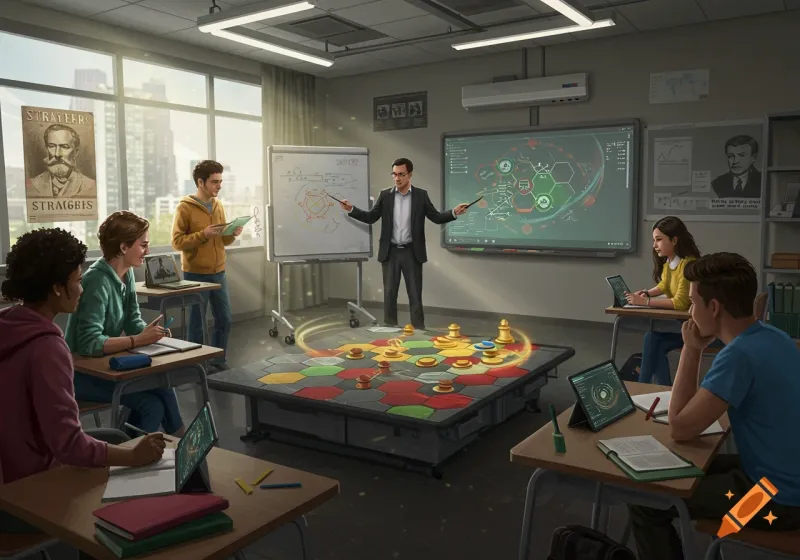
Photo: students playing physics game on laptops in classroom teacher watching, via media.craiyon.com
Walk into Mr. David Okafor's AP Physics classroom at Jefferson High in Columbus, Ohio, on any given Tuesday and you might think you stumbled into a LAN party. Laptops are open, students are shouting angle adjustments at each other, and someone just yelled "forty-two degrees, compensate for wind!" loud enough to rattle the periodic table poster on the wall.
Okafor isn't running a free period. He's teaching projectile motion — and he's been using a popular slingshot physics game to do it for the past three years.
"The moment I stopped drawing parabolas on the whiteboard and started letting them launch something, everything changed," he says, leaning back in his chair. "Engagement went up. Test scores went up. And a few of my kids started showing up at school early just to practice."
This scene is playing out in classrooms from Portland, Oregon to Boca Raton, Florida. Slingshot games — long celebrated in casual gaming circles for their intuitive pull-and-release mechanics — are finding a second life as legitimate pedagogical tools. And the side effect nobody planned for? A growing pipeline of STEM-literate students flowing directly into competitive gaming.
The Physics Is Real, and That's the Point
It's easy to dismiss a game where you fling cartoon projectiles at structures as pure entertainment. But spend five minutes with an actual physics curriculum built around slingshot mechanics and the academic rigor becomes obvious fast.
Trajectory calculations, elastic potential energy, air resistance coefficients, gravitational constants — these aren't Easter eggs hidden in the game design. They're the engine. Teachers who've caught onto this are using that engine to make abstract formulas feel like survival skills.
"My students used to glaze over when I introduced kinematic equations," says Priya Nair, a middle school science teacher in Austin, Texas. "Now I show them how changing the launch angle by five degrees changes where the projectile lands, and they're arguing with each other about the math. That's exactly what I want."
Game developers, for their part, haven't always built these experiences with classrooms in mind. But several studios have noticed the organic adoption and started leaning in. At least two indie developers who spoke with Slingshot HQ confirmed they've added "educator mode" features to their titles after being contacted by teachers who were already using the games unofficially.
"We got an email from a teacher in Minnesota who had basically built an entire unit plan around our game," said one developer who asked to remain anonymous. "We hadn't marketed to schools at all. She just found it useful. That told us something."
From Classroom to Competitive Scene
Here's where it gets genuinely interesting for the esports world: students who learn slingshot mechanics through a STEM lens often develop a fundamentally different relationship with the game than players who come in through casual channels.
They think in angles. They calculate before they launch. They understand why a shot failed, not just that it did.
Coach Marcus Webb, who runs a regional slingshot esports club affiliated with three high schools in the Atlanta metro area, has noticed the pattern clearly. "The kids coming out of physics-integrated programs adapt faster in competitive settings. They're not guessing — they're solving. That's a completely different mindset, and it shows up immediately in tournament play."
Esports recruiters at the collegiate level are starting to pay attention too. Several programs have begun asking prospective players about their academic backgrounds, specifically whether they've had any formal physics instruction. It sounds unusual until you realize that in a genre built entirely on applied mechanics, knowing the underlying math is a legitimate competitive advantage.
The Unexpected Recruiting Pipeline
For a sport that built its grassroots identity on accessibility — anyone with a phone or a browser can play — the idea of academic credentials mattering feels a little strange. But the recruitment dynamic developing here isn't about gatekeeping. It's about discovery.
STEM programs are surfacing talented players who might never have found competitive slingshot gaming on their own. Kids who wouldn't self-identify as "gamers" are sitting down at tournament tables because their physics teacher handed them a controller as a homework assignment.
Jasmine Torres, a sophomore at Arizona State, is a perfect example. She started playing a slingshot game in her high school physics elective as a way to visualize elastic force problems. By junior year, she was competing regionally. She's now on ASU's esports roster and studying mechanical engineering.
"I didn't even know competitive slingshot gaming was a thing until my teacher showed us a leaderboard as part of a class exercise," she says. "I thought it was just a school thing. Turns out there's a whole world."
That "whole world" is now actively courting the educational pipeline. Regional tournament organizers have begun partnering with school districts to host student-specific brackets, and at least one national organization is exploring a scholarship track specifically for players who can demonstrate academic achievement in STEM subjects alongside competitive results.
What This Means for the Genre
Slingshot gaming has always had an identity that straddles casual fun and genuine competitive depth. The classroom-to-competition pipeline doesn't change that identity — it reinforces it. It says that the physics at the heart of this genre is real enough to teach, deep enough to study, and compelling enough to build careers around.
For teachers like Okafor, the esports angle is almost secondary. His goal is getting students excited about physics. But he's not complaining about the byproduct.
"If a kid goes from my class to a tournament stage because they fell in love with projectile motion," he says with a grin, "I'm calling that a win on every level."
The slingshot, it turns out, doesn't just launch projectiles. In the right hands, it launches futures.