The Players the Slingshot Scene Is Leaving Behind — and the Designers Starting to Notice
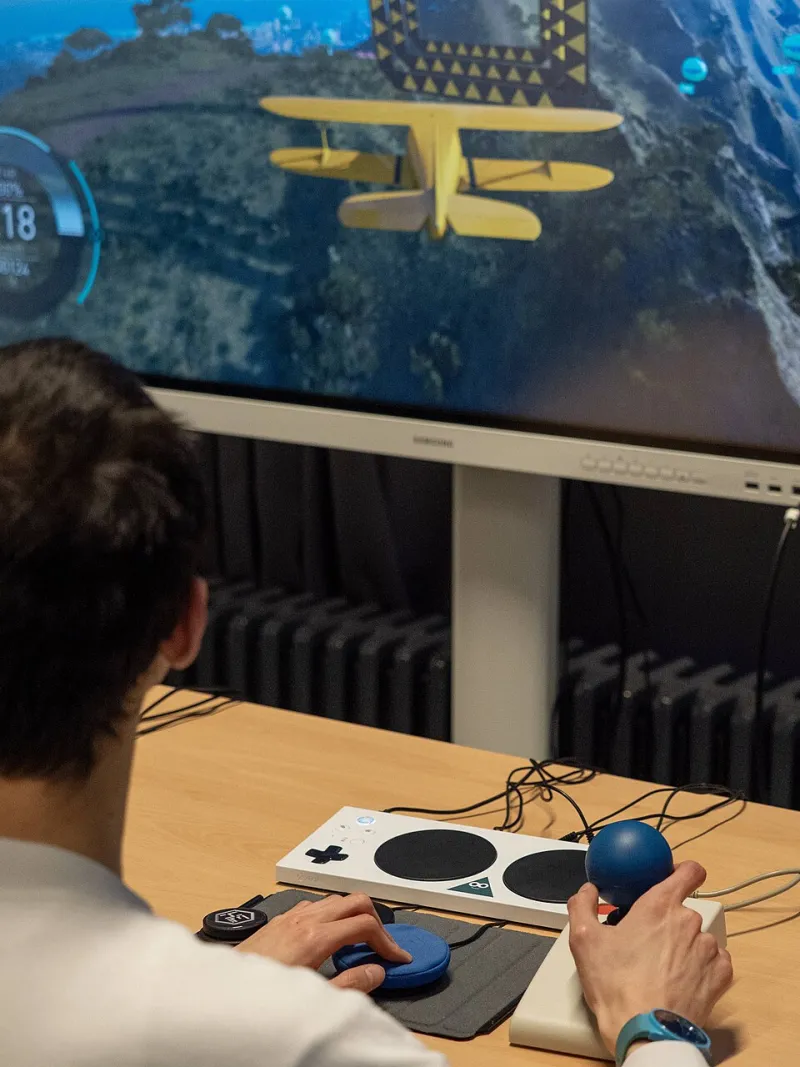
Photo: InclusiveGameLab, CC BY-SA 4.0, via Wikimedia Commons
Amara Osei has been playing video games her entire life. She's a dedicated fan of physics-based puzzle games, follows competitive slingshot tournaments, and has strong opinions about trajectory mechanics and release timing. She's also been functionally excluded from most of the slingshot titles she'd love to play, because her limited hand mobility makes the precision drag-and-release input nearly impossible to execute consistently.
"The irony is I understand the strategy better than most casual players," she says. "I've watched enough to know what good play looks like. I just can't do it the way the game assumes I can."
Her experience isn't rare. Across the slingshot gaming community, disabled players are navigating a landscape that was largely designed without them in mind — and the gap between what the genre offers and what it could offer is wider than most developers seem to realize.
What Makes Slingshot Games Specifically Challenging
Not every genre presents the same accessibility barriers, and slingshot games have a particular constellation of design assumptions that compound the problem.
The core mechanic — click or touch, drag to a precise point, release at the right moment — requires fine motor control, consistent grip pressure, and often split-second timing. For players with conditions affecting hand function, tremors, limited range of motion, or motor coordination, this input model creates barriers that no amount of skill or strategy can fully compensate for.
Beyond the input mechanics, many slingshot titles also rely on rapid visual processing. Fast-moving trajectories, time-limited power-ups, and screen elements that require quick scanning can exclude players with certain visual processing conditions or cognitive differences.
"The genre kind of doubled down on a physical metaphor in a way that made it feel intuitive for most players but genuinely inaccessible for a significant portion of the gaming population," says one accessibility consultant who has worked with mid-sized mobile studios. "And because the games feel 'simple' on the surface, developers sometimes assume accessibility isn't a concern. Simple to execute is not the same as accessible to everyone."
The Workarounds Players Have Built
In the absence of official accessibility features, disabled players have developed their own solutions — and the creativity on display is both impressive and a damning indictment of how much the industry has left to these individuals to figure out on their own.
Some players use adaptive controllers originally designed for console games, remapping inputs to switches or foot pedals that allow them to control drag and release without fine finger movement. Others have developed two-handed techniques that distribute the motor demand across multiple contact points. A small but active online community shares these workarounds through Discord servers and YouTube tutorials, essentially building the accessibility infrastructure that studios haven't provided.
Osei herself uses a combination of a tablet stylus and a custom mount that stabilizes her device, reducing the tremor interference that makes touchscreen precision difficult. It works — imperfectly, inconsistently, and only after months of trial and error.
"I spent weeks figuring out my setup," she says. "Weeks that most players never have to think about at all. That time and energy is a tax that disabled players pay just to get to the starting line."
The Indie Exception
While major studios have been largely slow to address these issues, a handful of indie developers are actively building slingshot-style games with accessibility as a foundational design principle rather than an afterthought.
One small studio based in Austin has been developing a physics puzzle game in the slingshot tradition that includes fully remappable controls, adjustable timing windows, a "slow mode" that reduces game speed without changing mechanics, and high-contrast visual modes for players with low vision or color processing differences. They consulted with disabled gamers throughout development, running playtests with participants who use adaptive controllers and assistive technology.
"We kept asking ourselves: who are we designing out?" says one of the studio's co-founders. "Every design decision excludes somebody. The question is whether you're making those exclusions consciously and for good reasons, or unconsciously because you never thought to ask."
The result isn't a watered-down version of the genre. It's a fully realized slingshot puzzle game that simply doesn't assume every player has the same physical capabilities. Early response from disability gaming communities has been enthusiastic.
What the Major Players Are Missing
The business case for accessibility in gaming has been made repeatedly and persuasively. Disabled Americans represent a significant consumer demographic. Accessibility features that help players with disabilities — adjustable timing, remappable controls, visual customization — also benefit elderly players, players in low-attention situations, and players using non-standard setups. The audience for accessible design is always larger than the audience you built it for.
And yet, major slingshot game studios have largely treated accessibility as optional polish rather than core design. When accessibility features appear at all, they're often limited to colorblind modes and subtitle options — meaningful for some players, but insufficient for those whose barriers are rooted in motor control or input flexibility.
"There's a perception that adding accessibility features is expensive and time-consuming," says the Austin studio co-founder. "Some of it is. But a lot of it is just about building the option in from the start instead of trying to retrofit it later. The cost is mostly a planning cost, not a development cost."
The Community's Role
Change in the slingshot gaming space isn't going to come only from developers. The community itself has a role to play — and some of the most effective advocacy has come from within.
Disability gaming organizations have been pushing for standardized accessibility benchmarks in competitive settings, arguing that tournament formats should accommodate adaptive input devices and that leaderboard systems shouldn't exclude players using non-standard setups. A few regional tournament organizers have begun explicitly welcoming adaptive controllers and offering modified format options.
The broader slingshot community, meanwhile, has an opportunity to signal to studios what it values. When accessibility features get highlighted in reviews, discussed in community forums, and rewarded with player enthusiasm, developers notice.
A Genre That Could Lead
Slingshot games have always been about the elegance of a simple mechanic — pull back, aim, release — executed with precision and creativity. There's nothing inherent in that concept that requires excluding players with disabilities. The exclusion is in the implementation, not the idea.
The developers who figure that out first won't just be doing the right thing. They'll be tapping an underserved audience that the rest of the genre has been ignoring, and building the kind of community loyalty that comes from being the studio that actually showed up.
Amara Osei is still playing. She'd like it to be easier to do so. So would a lot of people the slingshot scene hasn't bothered to ask.